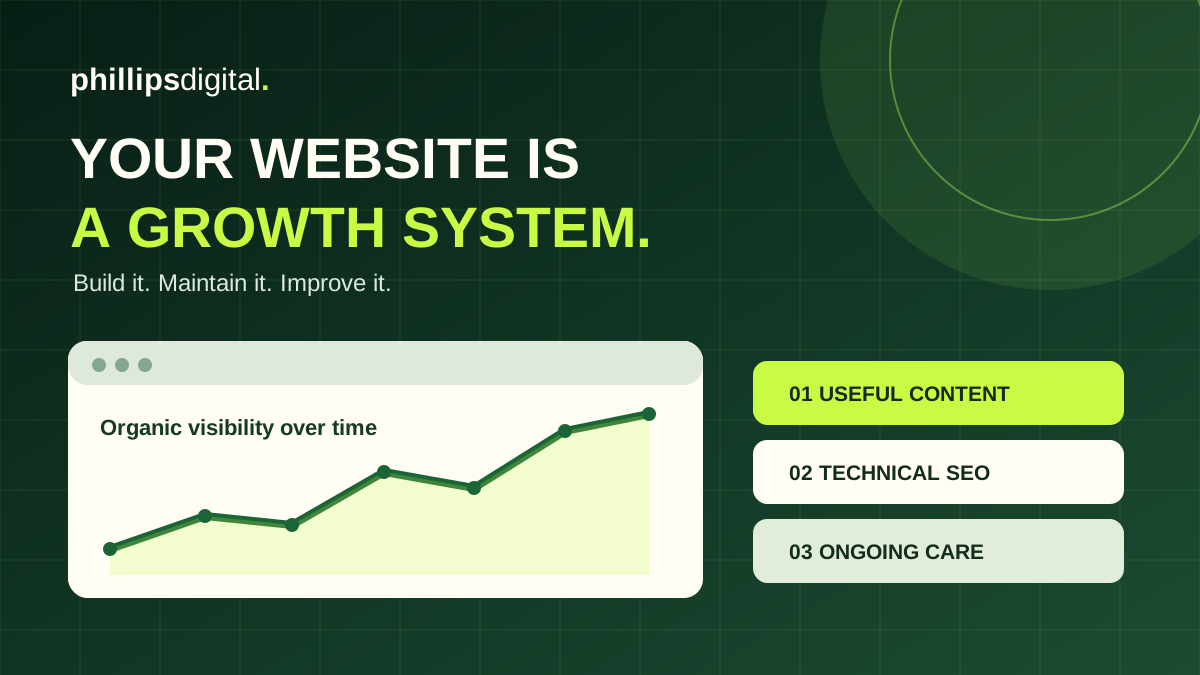
Why a free website does not necessarily mean free growth
Many website deals focus on the initial build: the visual design, a few service pages and a contact form. Those are important, but launch day is only the start of the website's working life. Without relevant service information, a clear path to enquire and basic search visibility, a site can remain a digital brochure that few potential customers discover.
That doesn't mean a one-off website is pointless. For businesses that already have an audience, an occasional simple site can be entirely suitable. The important question is what work needs to happen after launch—and who will do it? Compare the scope of support, not just the headline design fee.
Website maintenance vs SEO: what is the difference?
| Website maintenance | Search engine optimisation |
|---|---|
| Checking forms, links, hosting and site functionality | Making pages accessible to search crawlers and useful to searchers |
| Updating business information, images and technical dependencies | Improving titles, headings, relevant copy and internal links |
| Fixing layout, mobile or performance problems | Understanding the questions and topics potential buyers search for |
| Keeping the website accurate and reliable | Reviewing search performance and prioritising meaningful content updates |
Some tasks overlap: a broken mobile page or inaccessible navigation hurts both users and search visibility. But updating a page for the sake of changing it does not automatically boost its ranking.
Seven practical improvements that can help organic traffic
1. Give every important service its own useful page
A business offering several distinct services should explain each one clearly. A page about small business website design answers different questions from a page about brand identity design. Separate, genuinely useful pages also make it easier to link customers directly to what they need. Avoid making nearly identical pages for every town or keyword variation.
2. Match the wording to genuine customer searches
Fancy descriptions may sound creative but still leave a buyer asking what you actually do. Use clear phrases such as “website design and maintenance”, “small business website design” and “SEO support” where they naturally describe the service. Explain who the service is for, what is included and what the client can do next. Avoid repeating the same search phrase in every sentence.
3. Write original answers to questions customers ask
Good article subjects start with real buying questions: how much does website maintenance cost? What is included in a website care plan? How does organic traffic work? How can a site turn visits into enquiries? A practical guide can build trust, attract relevant searches and lead naturally towards the services you provide. For example, read our guide to small-business website costs.
4. Keep the technical foundations sound
Make sure your important pages are indexable, have meaningful titles, load appropriately on mobile, and link to one another with understandable navigation. Check for broken links and image problems, and make sure enquiry forms and booking buttons still work. Google's SEO Starter Guide is a sensible reference for these basics.
5. Make the next action obvious
Traffic is useful only when the visitor can understand the offer and take the next step. Clear examples, straightforward pricing or scope information, real proof and accessible calls to action help visitors make a decision. Test the mobile enquiry process rather than assuming it works.
6. Measure searches, not just social reactions
Use Google Search Console to track impressions, clicks, search queries and which pages Google indexes. Compare this with enquiries rather than treating every impression as a lead. A page getting impressions but few clicks may need a clearer title; a page getting visits but no enquiries may need better content or a more relevant offer.
7. Review content when something meaningful changes
Refresh a page if your services, prices, examples or customers' needs change, or if search data shows missing information. Publishing new content every day is not a ranking requirement. A smaller collection of accurate, genuinely useful pages can serve users better than hundreds of thin articles.
What should a monthly website plan actually include?
Ask your provider to separate the work they will perform every month from optional services. Basic hosting and uptime alone are not the same as hands-on editing, ongoing technical reviews and a content strategy. A sensible agreement specifies the update allowance, domain ownership, whether additional pages or copywriting cost extra, and exactly what happens if you cancel.
At Phillips Digital, our Website + Growth package costs £150 per month with the agreed standard website build included and no upfront design fee. It includes routine hosting and maintenance, up to one hour of small updates, basic technical SEO checks and organic visibility guidance. Major new pages, article production, larger SEO campaigns, advertising and domain costs are scoped separately. We don't promise a page-one Google position or a guaranteed number of leads.
A simple monthly website review checklist
- Open your website on mobile and desktop, and submit a real test enquiry.
- Check that contact details, services, prices and calls to action are accurate.
- Inspect your most important pages and links for errors or confusing navigation.
- Review Search Console queries, impressions, clicks and indexing warnings.
- Identify one genuinely useful content improvement or customer question to answer.
- Confirm your domain, backups or deployment, and website ownership details are understood.
- Record what changed and whether enquiries are improving over time.
Which keywords should a small business target first?
Start with services and buying intent, not the biggest headline search volume. “Website design and maintenance” may describe a service more directly than “amazing websites”. Educational searches like “why isn't my website showing on Google?” can support those commercial pages, provided the content gives a useful answer and doesn't force a sales pitch.
Keyword research tools provide directional estimates, not guaranteed visitors. Before expanding to new markets, use real search terms, customers' questions and Search Console evidence to decide what belongs on each page. A worldwide business doesn't need to pretend to have an office in every city.
Want a website that keeps improving after launch?
Our Website + Growth service combines the build with practical ongoing support, technical SEO and a plan for organic visibility. See the scope and ask a question before committing.
See Website + Growth — £150/month ↗